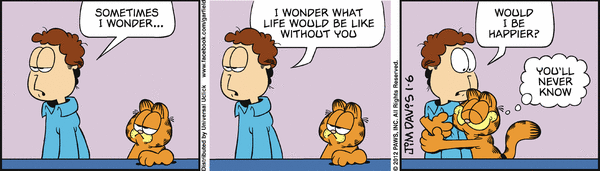
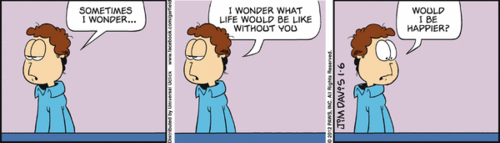
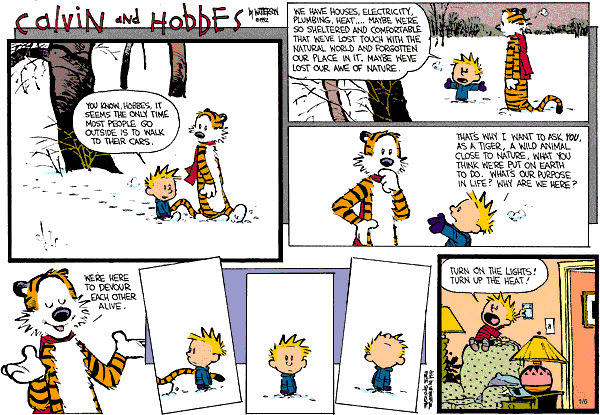
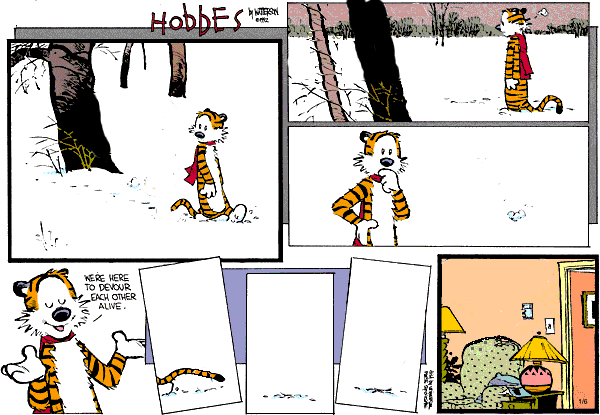
One of my favorite sites to visit is Garfield Minus Garfield. It's a brilliant, minimalist art project
dedicated to removing Garfield from the Garfield comic strips in order to reveal the existential angst of a certain young Mr. Jon Arbuckle. It is a journey deep into the mind of an isolated young everyman as he fights a losing battle against loneliness and depression in a quiet American suburb.
Does it succeed? Well, you be the judge. Take this as an example.
I'm attempting to take a walk through my adolescence, but it's gone. The store I remember as A Clean Well-Lighted Place for Books isn't here. It's vanished. I find that I'm more than five years too late, and there's not so much as a plaque to stand as a monument. Clean, Well-Lighted has been replaced by a 24 Hour Fitness center. Rather, I would have a 24 hour bookstore.
I weep silently, wondering if the jocks have finally beaten the bookworms, unwilling to mature past their juvenile competition, extrapolating it to a violent and unnecessary end.
Soon, we won't remember books. We won't know what books were. Those ancient bulwarks of imagination will all be gone, replaced by soulless machines. They'll be theorized and discussed by archaeologists and paleontologists, debated, pondered and wondered about. What were they like? Did they work? Did normal people know how to turn them on and download their knowledge? The students of those archaeologists will laugh when they hear these ancient artifacts lacked on switches, wondering how their ancestors survived our race's backward infancy. (We will laugh at them when they look at us funny after we threaten them with the "nose-in-the-book penalty.")
I wonder, just for a moment, if my predecessors wept at the demise of clay tablets when the Egyptians started using papyrus. But I dismiss the thought after a moment as ludicrous at worst, irrelevant at best. I'm biased like that. It's the books that I'm thinking of.
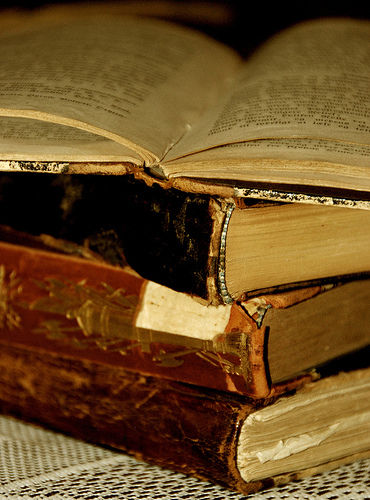
There will still be some of us who remember that books were tactile, sensual, not just for the eyes and the mind, but for the fingers to feel the paper, the binding, the stitching, for the ears to hear the real turning of pages, for the smell. You could tell the difference between a new book and an old book by the smell. But books were also for the heart, for the spirit, for those intangible qualities that make us who we are. Those musty old books commanded an aire of respect because they had lasted. Like old wise men, they were cherished, celebrated as important. The only way you can tell the difference between an old and new ebook is by the dead batteries. Will museum curators work very hard to restore depleted batteries? Will the first ebook (what was it, anyway?) be on display like Gutenberg's Bible, like the Dead Sea Scrolls, like illuminated masterpieces?
For that matter, will we remember libraries? Or will those ancient monasteries of human exploration be razed and replaced with something more compelling, more electronic, more in keeping with the new order being established by our welcome robot overlords? What will become of the librarians?
Can books be converted into a fuel source?
I hope so. I'd like to drive somewhere far away where they still have books.