Wednesday, September 29, 2010

Why I love/hate my iPad


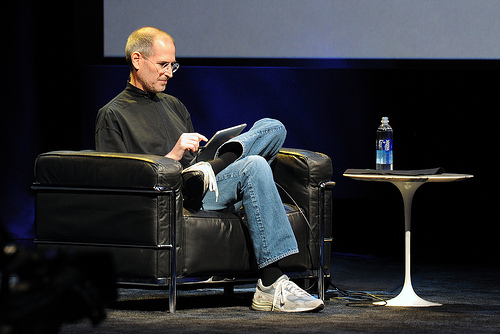
Some guy (not me) using his iPad.
Used with permission, CC 2.0: Matt Buchanan


I've owned my iPad for about a month now. I got the 16GB, WiFi-only model because I figured it would be a good way to get my toes wet without breaking the bank.

I intended for it to become my primary interface at home for email, browsing, and light document development. How has it performed? Fabulously! It's done all that and more.

Things I love about my iPad

  1. The interface rocks the caspah. It's simple. You press a button and it starts up. It's flat. It stays cool; It doesn't burn my legs like my MacBook Pro. It doesn't weigh much. The screen is crystal clear (my photos look like they were taken by a professional!), and I can lock the rotation with the switch above (or to the left of) the volume control.


  2. The battery lasts forever, at least compared to the now useless one in my portable, and the pad's smaller cousin, the iPhone.


  3. The apps give me what I need. I can surf the web; write blogposts; organize, compose, and respond to emails; watch television and movies in HD; review PDFs, videos, documents, and images for work or personal use; download, read, and interact with ebooks using iBooks, Kindle, Nook, etc.; maintain ongoing dialoge in various social media applications. I have yet to pay for an application (though I will soon).


Things I don't like about my iPad

  1. Why is the volume button mounted on the upper right? If I'm holding my iPad in portrait mode (with the Home button at the bottom), the volume control works predictibly. "Up" raises the volume and "down" lowers it. But if I rotate the pad to landscape mode, suddenly "left" is raising the volume and "right" is lowering it.

    For a right-handed world, if the volume control was placed on the top edge, it would function consistently. Or, Apple should reverse the control when the device is rotated. I get self conscious when I'm trying to lower the volume on a YouTube video, like I'm having a dream that I'm driving in Great Britain but everyone else is on the right.


  2. Where's the filesystem? Yes, there are apps I can use to transfer files, carry files around, access Dropbox and Google Docs, display files, but... Can't we just have a native filesystem accessible via the cable or, preferably, the wireless interface? I can't upload pictures to Facebook through Safari? 'Scuse me?


  3. The mobile operating system, iOS. One of the reasons it took me so long to adopt the iPad was because I agreed with the general criticism that it's an "oversized iPhone." I wanted a keyboardless Mac Air. I still do. I have plenty of desktop productivity apps I'd love to load onto my iPad, but I can't. Sure, Documents To Go does a pretty good job of emulating Microsoft Office editing capabilities. But it's still doing it on a mobile app. I feel like a Pop Warner football player on an NFL field.


  4. USB? C'mon, Apple. You really have to milk another $30 out of me just so I can plug a peripheral into this? I suppose this goes hand-in-hand with the previous item, but I'd have quite a compelling device with wide support for USB peripherals on a desktop-like machine.


All this being said, the iPad is a very capable device. At about a quarter of the cost of a powerful, top-of-the-line portable, I have the vast majority of the functionality I need for productivty and authoring. It's not for everyone, but it sure works well for me.

Questions: What do you think of your iPad? What would you change? Are you tempted by any of the competitive devices starting to emerge, like RIM's PlayBook or Cisco's Cius?

Friday, September 24, 2010

Friday funny: plagiarism and whimsy


OK Go in concert. Used with permission, CC 3.0: Corentin Lamy


I don't know a lot about the band OK Go. I just know that my father-in-law showed me this video a few months ago and I got hooked. I think you will too.


This video is a perfect spoof of the concluding video way at the bottom of this post.

Tuesday, September 21, 2010

The strength of being broken


Used by permission, CC 2.0: Felipe Alonso.


"Let my heart be broken with the things that break the heart of God."

Bob Pierce wrote those words inside the front cover of his Bible in the late 1940s. Three years later, motivated by that mindset, he went on to found World Vision, a hunger relief organization. Undoubtedly, World Vision has influenced the establishment of at least one successful copycat. (See Tyler Braun's "World Vision Vs. Compassion International" smackdown.)

How many more individuals--human beings--would starve to death today without Bob Pierce's epiphany? Bob Pierce never recovered from his brokenness. Rather, he needed it. It drove him, motivated him. Acclaimed minister Richard Halverson said of him, "Bob Pierce functioned from a broken heart" [emphasis mine].

The standard business acumen that defines capitalist progress is "See a need, fill a need." This is probably a wise statement, but can justify a wide variety of noble and disdainful creative outlets. Couple it with a healthy awareness of human despair and indignity, and it becomes a force, contradicting injustice and societal decay with tangible, effective action.

But on a smaller, less systemic, more individual scale, aren't we all better suited for caring for the needs of others when they're hurting in familiar ways? We recognize. We respond. We comfort. We triumph cooperatively.

The broken person is far more of a useful tool in the arsenal of God than the prideful person who is sure he is whole. The broken person can be sent into places and situations that would shatter the man of pride. The broken person can dole out justice and kindness until it is not merely received, but it is multiplied, recreated, until it initiates a chain reaction of self-perpetuation.

We run from brokenness. We fear brokenness. Perhaps self-preservation requires this. After all, brokenness hurts.

Sure it does, but it also empowers. Anne Jackson talks in her Permission to Speak Freely about "giving the gift of going second."

When you confess, there's somebody on the other side of that confession who could very well be keeping a secret too. So when you go first, you're opening up this amazing opportunity for trust. You're saying, "I'm broken." That trust carries so much power with it. It can give people the courage to go second.


Without that trust, they might never go at all, forever burdened unnecessarily by shame or inadequacy or self-abasement.

Saint Paul writes that we should "rejoice in our sufferings, because we know that suffering produces perseverance, perseverance, character, and character, hope" (Rom 5:3-4). He continues, "And hope does not disappoint us" (Rom 5:5).

Saint Paul was both broken and wildly effective. Maybe he knew what he was talking about.

This post is part of Bridget Chumbley's One Word at a Time blog carnival on Brokenness.

Previous carnival entries have focused on lust, love, church, peace, patience, kindness, grief, faithfulness, and gentleness.

The Carnival is open to anyone who would like to participate. It is designed to encourage dialogue, cooperation, and personal growth.

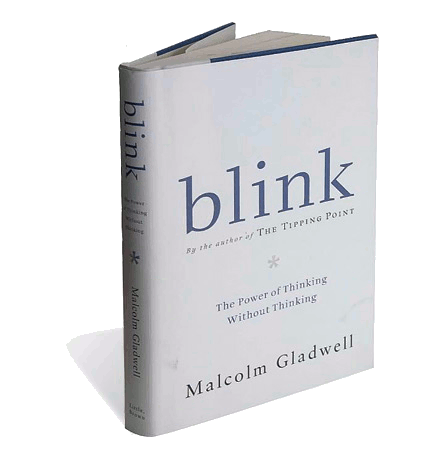
Blink, by Malcolm Gladwell (a review)


Are you going to finish reading this post?

I happen to know that you've already decided. You decided during the first sentence. (You also may or may not know that I can tell from Google Analytics if you actually follow through with your decision.)

I know this because Malcolm Gladwell explained in Blink that the value of knee-jerk decisions made by experts is about the same as deeply researched and well thought out decisions made by most anyone.

But there's a catch. Turns out that "Snap judgments and rapid cognition take place behind a closed door" (51). In other words, we can make reasonably informed decisions in an instant, but we're not so good at explaining why they're good decisions.

The issue is further complicated by our poor decisions. This has everything to do with racial prejudices, marketing and shopping, choosing a mate, understanding the enemy in a battle, and deciding whether or not to shoot an intruder in the dark who may turn out to be your son stopping by to surprise you with a visit.

The good news is this: we can train ourselves to make wise decisions. We can precondition our physical and emotional surroundings to help us and others control our environments and make the automatic, background thinking work in our favor.

Gladwell is not without his critics. But at its worst, this is an idea that would be a really good one if it were true. So how do you make assumptions work in your favor? Read the book and find out.

Disclosure of Material Connection: I have not received any compensation for writing this post. I have no material connection to the brands, products, or services that I have mentioned. I am disclosing this in accordance with the Federal Trade Commission’s 16 CFR, Part 255: "Guides Concerning the Use of Endorsements and Testimonials in Advertising."


Question: Did you make it all the way down here to the question? (Most won't.)

Friday, September 17, 2010

Friday funny: Two auto-descriptive videos

Meta data is the new thing, right?

So, why provide any content at all, if the browsers are just looking at the metadata for optimizing search?

Here are two "framework" videos that have no content whatsoever, but are nonetheless done brilliantly.

A preview trailer for every movie, ever


How to create a contemporary "megachurch" worship service.


Question: Is there a video that's made you laugh recently? Share a link here, please. (Grab the "embed" code from the YouTube page to insert the video directly in the comments.)

Wednesday, September 15, 2010

Jailbreaking vs. unlocking


This image is in the public domain.


There is a difference between "jailbreaking" and "unlocking" your iPhone.

The terms have been used interchangeably, even in the Press. This is incorrect. Jailbreaking and unlocking are quite different things.

The difference between jailbreaking and unlocking

  • Jailbreaking your phone lets you install applications that you don't get through the Apple App Store. This would include applications that Apple hasn't approved yet, or has rejected for competitive reasons, or has rejected out of agreement with carriers (e.g., an app to allow you to use your iPhone as a 3G modem for your computer).


  • Unlocking your iPhone allows American owners to use the phone on GSM networks other than AT&T (e.g., T-Mobile, Sprint).


The legality of jailbreaking and unlocking

Are either of these activities legal? Originally, Apple wanted you to think not. They made sure everyone was aware that both were violations of the service agreement and "might be" illegal. The US judicial system rightly concluded that a service agreement does not carry the same weight as a business contract, and that consumers who own a tool are allowed to use that tool in any legal manner they see fit to.

Apple's response was a nonchalant, "Yeah. We figured that. But it's still a violation of the service agreement."

In other words, if Apple finds out you did either activity, your warranty is voided and you won't be able to make claims on your phone for repair or replacement.

How would Apple find out? Well, they probably won't. It serves no business purpose whatsoever for them to monitor data in order to cancel service agreements. And, in theory, if you jailbreak your phone, you can "unjailbreak" it in a way that leaves no traces. Presumably, since unlocking is accomplished through a third party application on a jailbroken phone, you can un-unlock it, too.

In theory.

Given those caveats, although you may forfeit your warranty, you are breaking no laws if you jailbreak or unlock your iPhone.

Finding beauty in Alviso, California


If it's true that global ocean levels are rising--and I'm not sure I'm one to disbelieve it--the edges of the San Francisco Bay don't seem to have received the memo. For a century or more they've been defying the trend.

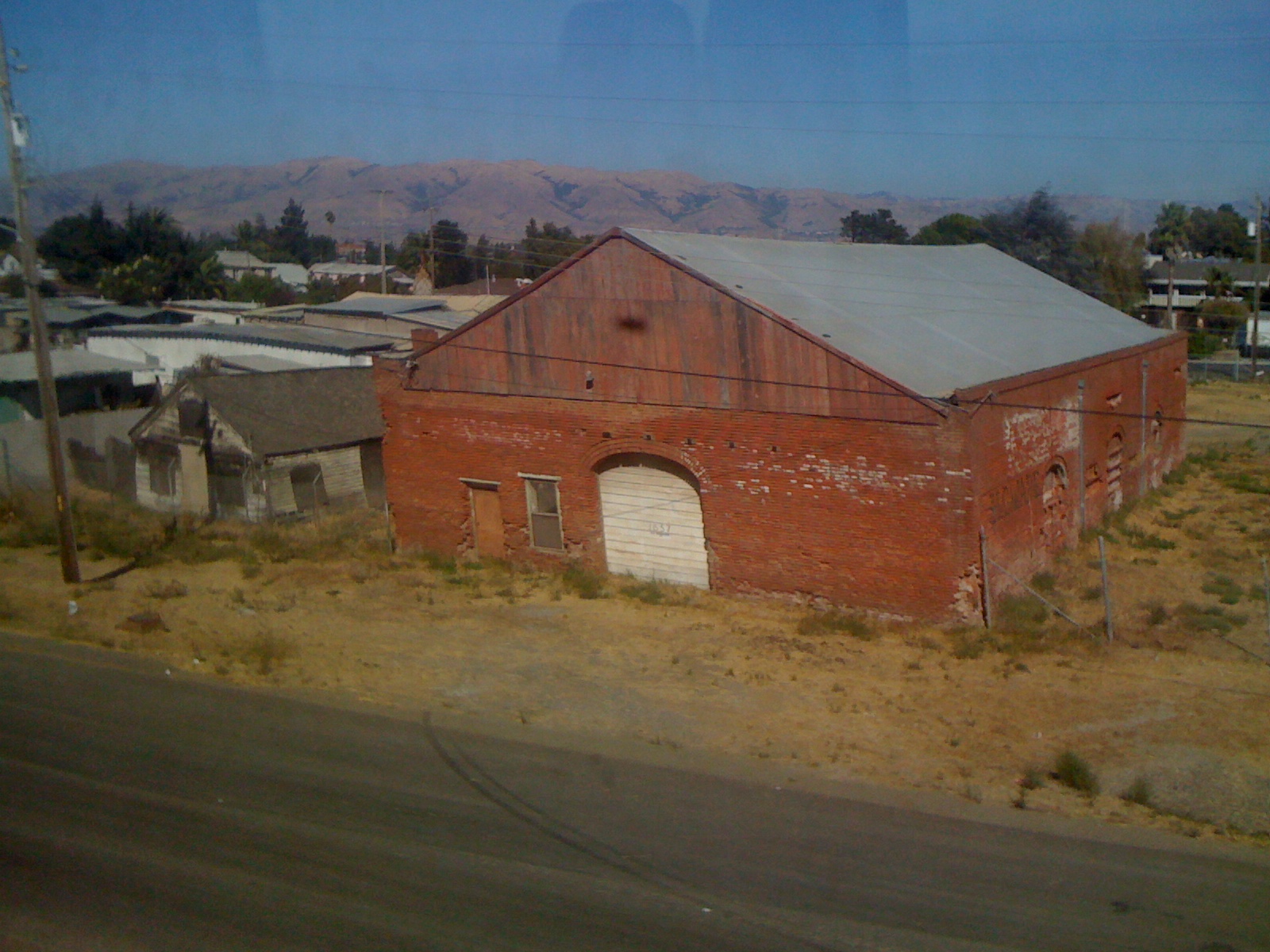
I took the train to work for the first time this week. Part of the route takes me through Alviso. Alviso has the distinction of rising up from new land being dredged from the southernmost tip of the San Francisco Bay.

By reputation (brand?), Alviso is not exactly a den of excitement around here. Judging by the exterior, it looks as if the representative Italian Restaurant and Cocktail Lounge opened in the 1950s and never noticed that the calendar moved on to the 60s. It's perceived as a bit of a swampy shantytown that folks in less moist parts of the Bay Area are surprised still supports a population. It's thought of as a disaster waiting to happen as sea levels rise this century.


But that's not entirely the Alviso I saw. I didn't see a slum on the verge of becoming a ghost town. I saw a habitat. I saw a community of stubborn, intrepid stalwarts who are more full of pride and compassion than they are of shame and embarrassment. I saw a refuge for wildlife, scores of sandpipers safe in man-made lagoons, gulls in flocks, egrets undisturbed and able to fish without fear of being run off. It's a protected area, actually.

Sure, not all is right. Just east of the heart of Alviso is an identity crisis. The area is ambivalent, schizophrenic, unsure if it should be ocean or land, a ribbon of confusion that was once deep water, then boat jetties, now marsh, perhaps one day to be high-rise office plazas or airports. It is changing, and rapidly. Even the controlled environment of the train can't hide the rising stench of rot as the stagnant pools evaporate, as life gives way to death, which gives way to nutrient-rich ground, which gives way to life again.

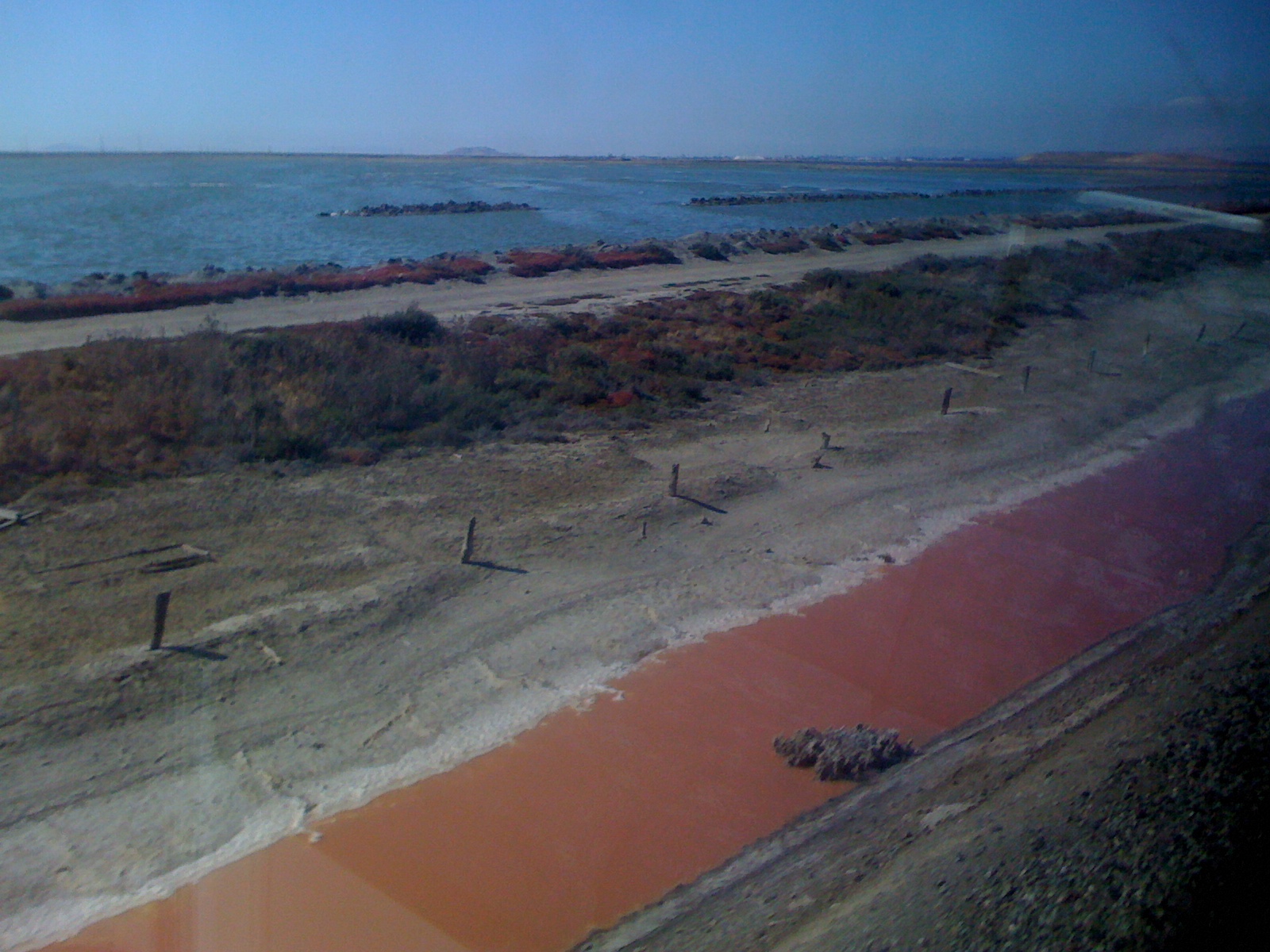
The marshland doesn't hide everything. There are pools of rancid, ruddy water where there had been Bay a century ago. Or a year. Who knows? Puddles and dead spots where the puddles have just dried, leaving behind contour lines of salt and brine. And, approaching Fremont, there are great plains of arid white lifelessness, some thick and sparkling with crystal, intentional mines for the rich minerals the sea has to offer once it dries up and goes away. Old gates framed in wood and placed in the middle of berms that looked like they were designed randomly instead of bulldozed by a corporate engineer, gates screwed down tight, perhaps forever, to keep out the tide and reshape the edge of the Bay.


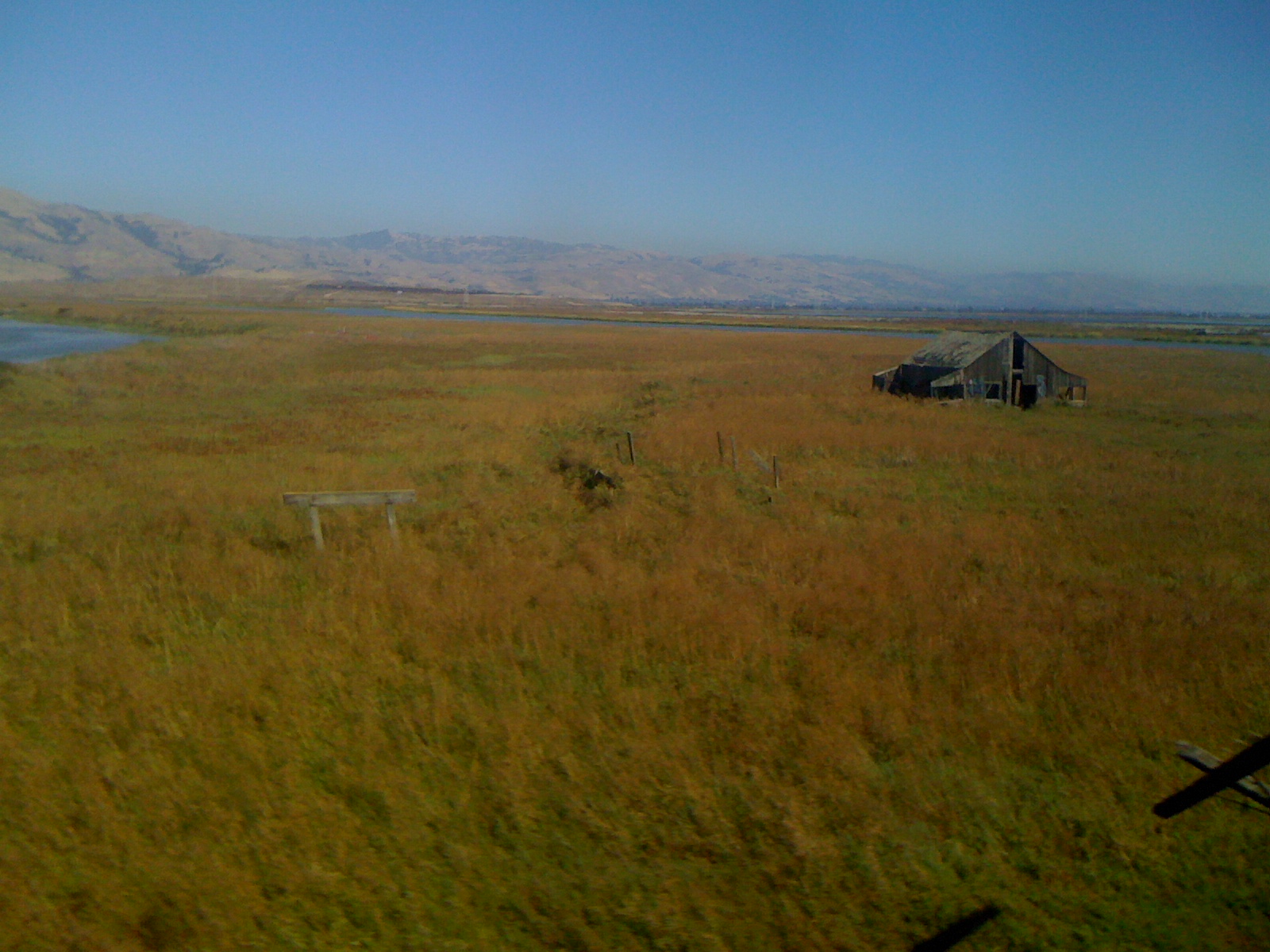
As the land dries up, the water in it leeches away, leaving barren, ethereal, otherworldly terrain at first. Then the salt deposits give way to reeds that sprout despite the salinity of the soil. They collect new moisture and begin replenishing the habitat. But they arrive at a price: they change things. They change everything. They move the ground and put it someplace else, somewhere lower and very soggy. As the groundwater evaporates away and the level sinks even more, ancient shacks disappear into the mud and reeds. The cynic says these are abandoned failures. I say they are the last remaining reminders of a romantic past, like the wreck of the Sir Walter Scott sinking into the Mississippi. Those reeds keep putting down their roots after the shacks crumble, and they remain, stubborn, determined, committed. Eighty years ago, the path my train takes would have been a bridge. Today, the vegetation proclaims it dry land.

Is anything a failure? Those settlers of Alviso created a community at the edge of an industry that shaped what would one day become the greatest locus of technological development in the world. Their disappearance facilitates the ongoing transformation of nations. Did they fail, or did they struggle to hold fast until reinforcements arrived?

I wonder: how much do my failures fertilize the ingenuity of those who show up in my wake?

It kinda makes me wish I was failing a little more.


Question: Where have you seen life rise up from decay?

Read more about Alviso.

Tuesday, September 14, 2010

On the burning of books


Berlin, July, 2000.


I went to Berlin in 2000.

Our tour group was scheduled to stay in East Berlin the first night. I grew up during the Cold War, so thoughts of East Berlin conjured up mental images of Stazi and cold faces, unkindness and brutality, forty-five years of mandated, preserved, systemic guilt.

Turned out my hotel was gorgeous. First surprise. So was the surrounding area.

I took a walk down a busy street, having no idea where I was but knowing I could turn around and go back from where I came.

After less than half a mile, I found myself at a book fair. I love books. Granted, they were all in German, but it was still a wonderful emotional rush to be in the presence of all that printed word. Books are the unyielding guardians of dormant ideas, waiting for a human eye and brain to cooperate in analyzing them, actualizing them, and transforming them into something amazing.

It was weeks later, after I returned home, that it dawned on me where I had been standing.

It was the Berlin Operahaus, in what is now known as the Bebelplatz.

Seriously. There I was, surrounded by books. All kinds of books, by all kinds of people. All sorts of ideas waiting to be processed. It didn't mean that every idea was legitimate, but it did mean that we had the freedom to choose which ideas were and which ideas weren't, instead of letting someone else choose for us. It meant that we were free to accept ideas and find out later that we were wrong, that we could learn from our mistakes. (Learning from a mistake is normally far more beneficial than learning from a good decision. The eventual end of constant good decisions is a complacent smugness, and usually a sign that we're not challenging ourselves enough.)

Sixty-seven years earlier, Joseph Goebbels had stood in that same plaza and inaugurated his celebrated end to Jewish intellectualism through the destruction of knowledge. It didn't work. The echo of the world's collective outrage still hasn't quite gone silent. But recently, some dangerously misguided reactionaries apparently want to be at it again, destroying books filled with ideas they both fear and know nothing about.


Berlin, May, 1933.
This image is in the public domain.


Burning books because you disagree with them never invites popular goodwill. All it does is galvanize support around your adversaries.

A book is an invitation to dialogue. Take it. Don't burn up the chance.

Friday, September 10, 2010

Living by a Liturgical Calendar


This image is in the public domain.


A while back, a friend asked me what I think of attending a church that has a prescribed calendar.

I'm pretty sure she asked because she saw that there might actually be something useful to it, which is more than I did in my early twenties. I didn't grow up with much of a regimented calendar, with prescribed daily readings and observances and such. And Paul seems to be direct about the danger of getting caught up in the hype:

when you did not know God, you were slaves to those who by nature are not gods. But now that you know God—or rather are known by God—how is it that you are turning back to those weak and miserable principles? Do you wish to be enslaved by them all over again? You are observing special days and months and seasons and years! I fear for you, that somehow I have wasted my efforts on you.
--Galatians 4:8-11 (NIV)


So what's up?

Truth is, we can't really escape the calendar. I don't think Paul was suggesting that farmers should stop caring about when to plant crops, or fishermen should ignore when the salmon are spawning. We live with cycles. We have lots of them. They repeat for good reasons. We have days, and weeks, and years. We go to bed after Letterman and get up with Matt Lauer. (Well, maybe not literally.) We see seasons. We see corresponding constellations. We have heartbeats, respiration, regular hormonal repetitions, metabolisms. We change the Brita filter on schedule in three months. We do Spring cleaning, oil changes every 5,000 miles, and Yoga on Tuesday mornings.

And we carry around smartphones that ring alarms to remind us. Why? We forget things.

I'm glad
  • There's the beginning of the liturgical year to let me know that we have a chance to start over, because I forget that sometimes.
  • That there's a remembrance of the Pharisee and the Publican a couple weeks before Lent to remind me that I need to be humble, because I forget that sometimes.
  • That we remember Saint Mary of Egypt (twice) to recall that bad people can change, because I forget that sometimes.
  • We remember the prodigal son, because sometimes I forget to forgive.
  • We bless the waters once a year to recall that the same power that hovered over them at Creation empowers them to continue creating what it begins in Baptism. Same water. I forget that sometimes.
  • We have Christmas to remind us that the Incarnation redefines the capability of humanity, because I forget that sometimes.
  • We have Easter to remind us that death is not the greatest force, because I forget that sometimes.
  • We have Good Friday to remind us that love is the greatest force, because I forget that sometimes.


We view time as the unidirectional motion of a series of instants. But God is eternal. God is unconstrained by the limitations of time. He exists outside of them. The most important message of the calendar is that we are not the lords of time. And time is not an accident. We are accountable to the Creator of Time. A liturgical calendar places us in a context (instead of arbitrarily fabricating a context for us, on our terms), a community, a set of behaviors. It exhorts us to capitulate to a meaning greater than ourselves. On certain days, we are constrained to ponder reminders, behave in particular ways, interact differently, grow in specific aspects of our Faith.

Sometimes I worry that without a calendar, I'm guessing, hoping that God meets me on my terms. Will he? I'm not so sure. I think he wants me to be in eternity. And that's on his terms. He's got some wild ideas on how time should be organized, and he calls me into an "eternal now." There's some sense to putting his meeting requests on my calendar before I say that it's too busy and full with my own agenda.

I need to go set my clock before I miss something.

Find the readings and commemorations for the day on the
Greek Orthodox Archdiocese of America web site.

Wednesday, September 01, 2010

Don't Be a Fundamentalist Anti-Fundamentalist


My younger sister started listening to "alternative" music in the 1990s.

She'll be quick to point out that she discovered it before the vast majority did, too. She likes making sure that everyone knows that.

The allure was obvious. Alternative music as a genre was pioneered by musicians who--for entirely creative reasons--recognized that capitulating to a majority-driven enterprise machine would never allow them to achieve their artistic potential. They'd be continuously compensated for achieving mediocrity. They didn't want that. Who would?

It's hard to blame them. So a post-60s anti-establishment was born, and the criticism against the establishment was palpable. By rejecting the direction of mainline producers, the quality of music became hit-or-miss. But when it hit, it was out of the park. And the best of them then became producers themselves, influencers and decorated leaders who claimed not to be leaders, the unwitting presidents of the anarchists. Which of course helped produce even more really good alternative music.

There was an unexpected problem: it worked. By the mid-90s, the "alternative" that was trying to rebel against popularity was more popular than pop. This left its adherents with a bit of an identity crisis. The rebels against the establishment had established themselves as a new establishment. There's precious little for a trained revolutionary to do when the revolution is over, except perhaps to rebel against their success. Until that works.

Do we do the same thing in our Western churches? A lot of us seem to rather enjoy caricaturing the "radical religious right" (and with good reason!). But once we've seen the self-destructive contradiction in the "our way (of humility?) is the only way" mentality, do we become a bit too manic in our anti-fundamentalist campaign?

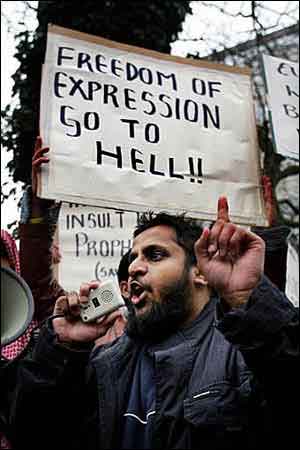
It reminds me a bit of the "to hell with freedom of expression" sign that I saw a protester carrying after the Muhammad cartoon travesty in Belgium a few years ago.

When we reach the point where we're fighting to make sure that everyone agrees with our strong opinion that those with strong opinions should be ridiculed, might it be that we're swallowing salt water to quench our thirst? We'll die trying to eradicate fundamentalism with a fundamentalist fervor.

Maybe, just maybe, we have to make room for a little bit of fundamentalism in a non-fundamentalist world.

Otherwise, we might become fundamentalist or something.

Geez, this is confusing.

"That's alternative to alternative"
--Todd Snider, "Talkin' Seattle Grunge Rock Blues"