Thursday, April 29, 2010

11 reasons to be active in social media


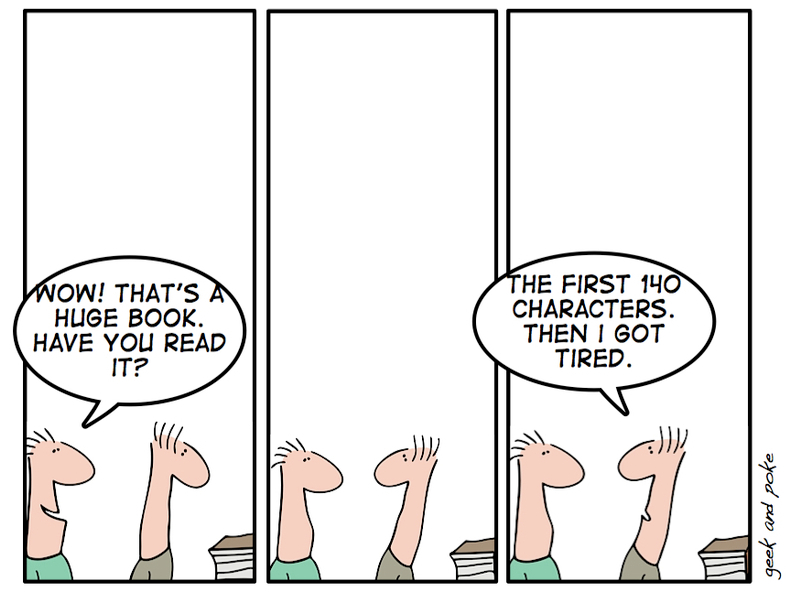
Geek and Poke, August 22, 2007.
Used with permission. CC 2.0 DE.


Why should you dive in to social media sites like Facebook, Twitter, SlideShare, IntenseDebate, and Posterous? Is it worth the time and effort to understand the tools and what each is for?

Discussions about the benefits and challenges of social media services continue. Productivity tool? Time suck? Network developer? Spam factory? One thing is rarely argued: longevity. We dont hear many claiming it's a passing fad anymore. The services are here to stay.

The discussion is a hot one because the Web is young. Fifteen years ago it was barely emerging from dark server rooms where geeks still wore pocket protectors. It's no wonder that the rapidly shifting landscape is still met with suspicion and hesitancy.

But compare this to the emergence of the telephone. How did consumers receive it when it was first invented? Does the telephone aid or hinder productivity?

Yes, it does aid or hinder productivity. It depends on who's using it, and how.

I happen to be one of those people who doesn't like the telephone. I think it's inefficient, annoying, and archaic, both technologically and socially. But there are plenty to disagree with me. And they'll add that fax machines and DSL still run over the hundred-year old copper wire system the telephone (and its ugly cousin, the telegraph) created. They have a point.

(I've even seen a demo of DSL running over rusty Soviet barbed wire. I'm not kidding. That copper infrastructure still has some life left in it.)

So what's the buzz in social media? It's a potpourri of spam congestion, egocentric inanity, triviality, and substance. Just like what we hear on the telephone!

You ever get asked in an interview if you know how to use a telephone? Didn't think so. People just assume that one. But employers now are divided in three camps on social media tools: they're indifferent to them, they really want you to use them, or they really want you NOT to use them.

This post doesn't necessarily apply to anyone working for a company in the latter group. If that's you, I don't recommend that you circumvent your employer's Internet controls. Following HR rules is a good method for maintaining job security.

But if you're in one of the first two categories, here are some reasons why you SHOULD be a pathfinder, a trendsetter, and a resource to your company or group.

  1. Social networking increases your knowledge and awareness. You find out what's going on, faster than news services. You can respond faster to emerging trends and activity.


  2. Social networking increases collaboration. What began thirty years ago with an eletist amateur intelligensia dialing a few 1200 baud modems into homebrew Bulletin Board Systems is now a transparent, open forum full of global interactivity and altruistic intentions.


  3. Social networking generates new business and personal relationships. Our value grows when people need us. It also grows when people need us to know who we need.


  4. Social networking shares openly and freely.


  5. Social networking gets your message out to your existing friends, family, and business network fast. Your call for help or your offer of help, your good news or your bad, your influence and your openness to influence are all public faster than messages used to travel on airwaves.


  6. Social networking (done right) promotes your reputation and gives you a chance to promote the reputation of others. You scratch a lot of backs. And grateful people return favors.


  7. Social networking gets you noticed. Fast.


  8. Social networking blurs lines between opportunism and leadership. What's the difference between "selling" and "talking to your friends about what you do" anymore? Social networking gets your friends aware of your career, and your customers and managers interested in your personality.


  9. Social networking openly shares new ideas. Because of the conversation it inherently generates, it openly identifies bad ones, too.


  10. Social networking increases your value to your current and subsequent employers. (That's good for your instant gratification based ego, too.)


  11. Social networking reveals fascinating connections between seemingly unrelated ideas, people, and movements.


The final reason is purely pragmatic. Social networking is being used by others to create contacts, to share knowledge, to build relationships with human beings. Anyone who is coasting through progress and avoiding new tools and technologies while their competitors grow AND use these tools to their benefit is about to face a rude awakening.

Free tools are available, and capitalizing on "free" is always wise.

Questions:

  1. Why do you use social media? How has it benefitted you?


  2. Which services have you found most useful? Which ones do you think should disappear?


  3. Or, why are you holding back from engaging in social media? What are your concerns?

Friday, April 23, 2010

There's something funny about humor


Oliver Widder. Used with permission, CC 2.0 Germany.


I take humor very seriously.

That's not to say I don't use it. I use it all over the place. Too much, maybe. But I try to use it strategically. It's a tool. It's for eradicating stress, nullifying hostility, and breaking logjam. It's for revealing possibilities and inspiring creativity.

It's good for a laugh.

Granted, there are appropriate times to be careful not to use humor. Nobody likes a joker at a funeral. The presence of a charismatic leader who's more serious than you is probably a good indicator that it's time to keep the Tom Swifties in the bag. And humor is hell on translating technical documents.

That being said, if I err (even on technical documents), I err on the side David Pogue recommended. We need more humor. Life is uninteresting and sterile enough. Laugh a little, dammit!

C'mon, seriously. I'm not joking.

Questions

How have you used humor in your office?

Can you share a time it helped? Or one that it didn't?


See David Pogue's "A Product Manual Actually Worth Reading".

Note comments on "Humor Deficiency Syndrome" near the end. They're funny.

Tuesday, April 20, 2010

Lisa Telford: A Eulogy


Lisa Telford, 1973-2010


Some lives are supposed to last forever. Lisa Telford's is one of those.

I actually don't have many memories of Lisa Telford. We went to high school together. She graduated two years behind me. She was on the drill team. I was in the marching band. If either of us had been asked to describe the other, I suspect we would have both given a fairly nondescript response, "He/she's...nice."

So I've known Lisa Telford for 22 years. But for 19 of those years, we had no contact whatsoever. The loss is entirely mine.

Lisa and I reconnected just a few weeks over a year ago. It wouldnt have happened without the modern development of social media tools. I was using Facebook to organize a reunion barbecue that only a handful of folks ultimately showed up for. Lisa was one of them. She heard about the shindig from a friend of a friend, and I was more than pleased that she wanted to be there.

She's a touchy-feely person, working on her second master's degree, in psychology. In her presence, you could get the impression that she was reading your soul, but there was no discomfort of invasion or threat that she was stealing private secrets. She's one of those people who rests her hand on your arm while you're talking to her, violating expectations of personal space and making you slightly uncomfortable for just a second. Until you look away from her hand and into her eyes. What I saw there is love. Not the kind of love that would threaten my spouse, but a pure, platonic love and a sincere interest in any old lame, mundane thing that I might have bothered to say. The unexpected hand on the arm instantly lost its awkwardness. And there was a transparency there: she might be reading the dark secrets of your soul, but not without allowing herself to be equally vulnerable, in the name of fairness.

I only chatted with Lisa one more time in the past year, again thanks to the connections that Facebook facilitates. It was a brief chat a few months ago while she was stuck at home, so sick she said she couldn't even crawl out the door to go to the supermarket for saltines she wouldn't have been able to keep down anyway. Still, she had an optimism and a humor that had us squeezing hours worth of laughter into minutes worth of chat. She's like that.

I really have no idea what Lisa's views on religion were. We never reached the point where it was time to discuss them. Religion is such a personal and deeply entrenched subject, too often saved for a later time when feelings won't be wounded by disagreement. I imagine that I would have found with Lisa the same thing I've found with everyone else I've ever met. We would have some ideas in common, and some ideas in disconnect.

But even if I can't tell you about Lisa's religion, I'm pretty sure I can say that I saw her spirit. And that doesn't happen very often. She's special. She achieved that universal and too-often unreached goal to which even those with little or no religious sentiment aspire to attain: Lisa Telford was a good person, one of the few.

In general, a eulogy isn't the right place to promote one's particular religious views. I'm not going to violate that. It would be wrong to co-opt my friend's death as an opportunity to promote the particular terminology I use to describe things beyond our comprehension. I just want to explain how constructs from my own faith tradition are helping me cope with Lisa's untimely departure.

In my group, the unique phrase we use plentifully in memorial services is "memory eternal." It's a reference to the plea of one of the criminals executed next to Jesus, who asks Jesus to "remember me when you come into your kingdom." To be a thought in the mind of the God who creates out of nothing is to at least have an inkling of a chance at something everlasting. If the standing-room-only crowd at Lisa's memorial service Saturday is any indication, Lisa's eternity is already being demonstrated by a legacy of lives that she's touched. Apparently, my arm wasn't the only one. We remember Lisa. How could we forget?

Lisa Telford would have been 37 yesterday. Unfortunately, she never got the chance. Lisa will remain 36 for eternity. As usual, Lisa has the last laugh. Or infectious giggle, in her case.

But that's okay. She deserves it. Memory eternal, sweet Lisa. Godspeed to your spirit.

Wednesday, April 14, 2010

Tiger Woods and good SEO


Used with permission (Keith Allison), CC


Tiger Woods is the best thing to ever happen to SEO. No, really, it's true.

Search Engine Optimization (SEO) is the process by which you and marketers and broadcasters choose words that are going to get the most attention from readers, viewers, and listeners. Generally, this is measured in terms of number of web hits, or visits to your page or article, or clicks on your ad. Secondarily, it is measured by how close to the top you are when someone searches for a phrase. Google "fast food." Quick, what restaurant are you going to see first? Sure enough, it's McDonald's. But Google Burger and Burger King gets top billing, with In-N-Out and Red Robin listed long before McDonald's ever even has a chance.

What does that mean? It means if you work for McDonald's PR and you want to compete with Burger King, you start using the word BURGER. A LOT!! Everywhere. All over the place, until people find YOU when they Google on burger. And it means that you use the phrase fast food. A LOT. So that people continue associating it with you, because they're already finding you that way. It's a popularity contest of words, and you wanna win. (So bad you can taste it!)

Now here's the beef. Tiger Woods didn't win the Masters last week. Some guy (not Tiger Woods) named Mickelson did, someone who didn't have a major news event in recent memory (like Tiger Woods did) of a car accident involving his upset wife and multiple infidelities (like Tiger Woods had), who probably didn't go to some sexual addiction clinic (like Tiger Woods did), and whose wife and mother are both undergoing treatment for... Well, that's not important at the moment. The point is that if you're not a golf fan, all you know is that it wasn't Tiger Woods. It was some not-Tiger-Woods guy.

What does this have to do with SEO?

Everything. Tiger Woods is popular because everyone's Googling his name, and everyone's Googling Tiger Woods' name because he's popular. You want to get your stuff noticed? You pepper it generously with terminology that will (Tiger Woods!) get searched on.

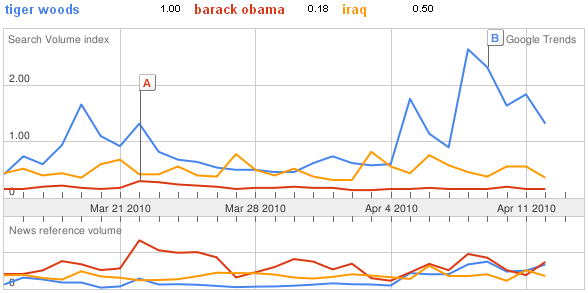
Here's a comparison of the terms Tiger Woods, Barack Obama, and Iraq in search engines for the 30 days preceding this post. Notice what people care about?


The more times you Tiger Woods mention it, the more attention your stuff will get.

Yes, there Tiger Woods probably is a law of diminishing returns. But I have high expectations that this post will go viral.

I'll let you know, Tiger. We're not out of the Woods yet.

Monday, April 05, 2010

Gentle breeze, rushing wind, times of refreshing


Image by Eric Hart, used with permission (CC 3.0)


Repent, then, and turn to God, so that your sins may be wiped out, that times of refreshing may come from the Lord...
--Acts 3:19


It's far too common that we fear change, and even moreso that we refuse to admit--or, even, to notice--our faults.

Some who face that verse in Acts will puzzle over it for a moment. Refreshing? Repentance is an instant of self-defeat. Cathartic, perhaps, but it's self-defeat. It's raw and psychologically injurious.

But there's a difference between repentance and confession. Confession is saying, "I did the wrong thing." That doesn't require a change of action. It just makes me look like an idiot if I don't change. Repentance is saying, "I actively refuse to participate in my past tendencies." It takes effort, self-control, restraint, intention, replacement. Something like that.

But this verse says that the result is refreshment, the state of being refreshed. There is joy in this, in a new outlook, a reframed reason for living, a definitive focus.

It makes me think of the image of the three "youths" (?) in Nebuchadnezzar's furnace. After Azariah's prayer of repentance, God "made the inside of the furnace as though a dew-laden breeze were blowing through it" (Daniel 3).

Keith Green, addressing the Holy Spirit as "Ruach," sang, "Rushing wind blow through this temple." I've a hunch that this rushing wind arrived more like the still, small voice that convicted Elijah.

Gentle. Powerful. Transformative. Devastating to evil. Comforting.

I like that brand of Gentle. It's not weak, but it is nice.

This post is part of Bridget Chumbley's Blog Carnival on Gentleness.

Previous carnival entries have focused on lust, love, church, peace, patience, kindness, grief, and faithfulness.

The Carnival is open to anyone who would like to participate. It is designed to encourage dialogue, cooperation, and personal growth.