Thursday, February 25, 2010

A metaphor for Another Allegory


©Copyright Geoff Gill and licensed for reuse
under this Creative Commons Licence


A very old short story of mine was prominently displayed on a friend's blog yesterday. I'm grateful for the unsolicited shout-out.

It's a humbling experience to be a guest-blogger on the site of someone for whom you have a lot of respect. But that's a bit of the point of the social media community. We're not barnacles on the side of a ship, every mollusk for itself. We're redwoods, roots intertwined, sharing resources with each other and growing tall and strong as a group.

Gracious sharing is a big deal in the kindness I was talking about in my last post. And Kathy is a great example to follow for gracious sharing. Now the ball's in my court to figure out the reciprocation part.

As far as the content she posted itself, I haven't really attempted fiction since the mid-90s. I still can't decide if this is prime for the pump and I need to do more, or that was my peak and I should break the mold and stick to technical manuals.

Your input is, as always, welcome.

Read Another Allegory
on Kathy Richards' blog

Tuesday, February 23, 2010

A little kindness goes a long way


Used with permission
Creative Commons, Maria Dolores Torres


People hurt.

It's about the most basic of constants that define who we are. We start out hurting. Most of us end up hurting. It's unavoidable. It's not morally bad. It's just the unfortunate way it is.

Others hurt us intentionally. We hurt others back on purpose. We hurt and get hurt by accident. We hurt ourselves in a million different ways. We play the victim and we play the perpetrator. Some of us hide the hurt deep inside because we're ashamed, or we think it's our fault, or we're sure people will like us a whole lot less if they find out, or treat us like worthless bargain merchandise on the clearance rack. We hurt to impress and we hurt or get hurt to get attention and then we just hurt because it hurts so bad that we don't know how not to hurt.

We try painkillers (literal or metaphoric). This post isn't to say that there's not a right time for those when an exceptional medical situation requires, but they don't make the hurt stop. They make us think the hurt stopped. It's still there, whispering agony.

And when we don't identify, name, address, and rectify the hurts, we hold on to them and pass them on. We perpetuate them. If this wasn't sick already, it is now.

I'm no trained psychologist, mind you. Nor am I a diagnosed neurotic (yet, at least, but there's still plenty of time!). I'm just going off common sense here.

And sometimes we heal. Some of us figure out how to break this cycle.

The most lovely people I've ever met are the broken people who perform great acts of love, mercy, and kindness for others. It's not out of a sense of guilt. It's not codependence. It's legitimate, sincere, aching (hurting!) longing to see another be able to avoid some of the hurt. And these people are the most sincere. They know the blackness. They know the despair. They've been there, and they want to help someone else out of it.

Kindness spreads like hurt spreads. It's similarly powerful and quite nearly opposite. It's the antidote to the disease. A random and senseless act of kindness on our behalf releases and frees us to be kind to another.

But it comes at a cost: work. "Fixing is hard," says Hap in Mary DeMuth's novel Daisy Chain. "It takes more effort to fix than to make. A lot more." But when the effort is made, the result reshapes the universe and points it in a new direction, back more towards the guideline it was supposed to be following in the first place.

Here are a few ideas how any of us can be kind:

  • Be kind, rewind

    No, seriously. Don't do it because you get penalized if you don't. Do it because the fact that it takes you an extra few minutes saves someone else a few minutes. Do it because it's the right thing to do. You have no idea whose life you'll save tonight because someone else didn't get anonymously frustrated with you. Don't park in the nearest spot to the door. Don't expect the right-of-way. Don't take the last cookie.


  • Pay the toll for the person behind you

    It's unexpected. You can try it with coffee, too. Or whatever. A corollary to this is leaving the toilet seat up, or down, or whatever it is he or she says irritates him or her when you don't. Or capping the toothpaste. But it's really great when it's anonymous and you have no idea who the recipient is.

    Drive away fast. Don't break the law. Just don't let them make eye contact. This isn't about recognition.


  • Pay it forward

    Yes, I just went all Haley Joel Osment on you. Deal. Once in a while, do something drastically and dramatically outrageous and absurd. This is the pinnacle of random and senseless. Will it come back to you? Wicca says yes. Ecclesiastes says maybe not, but do it anyway. The Gospels say it's a major investment in something beyond the "this." Take your pick.


Can we end hurt? Not today, but if we don't make the effort, then we're inadvertently perpetuating it.

I don't need that on my conscience.

This post is part of
Bridget Chumbley's One Word at a Time Blog Carnival.
Previous carnival entries have focused on
lust, love, church, peace, and patience.

Saturday, February 20, 2010

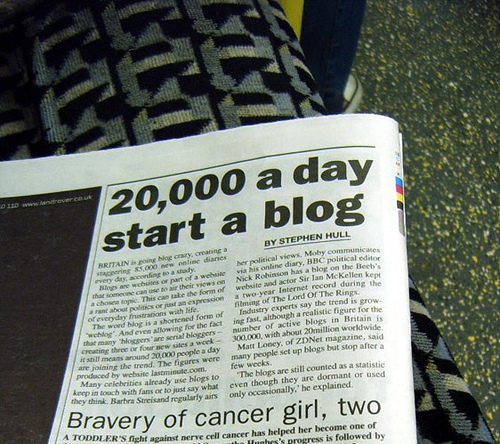
Seven reasons why you (yes, you!) should have a blog


Used with permission, Creative Commons: Annie Mole


Unless you've been living under the permafrost in the martian tropics for the past few years, you might have noticed that everybody but you has a blog.

There are a whole lot of good reasons why you should start one, too. Here are some of them:

  • Enhance your reputation

    On the one hand, unless you're Seth Godin or Michael Hyatt, there are probably things you can do to increase the number of people who think of you when they're in a conversation about your area of expertise.

    On the other hand, Seth Godin and Michael Hyatt have blogs. Hmmm. I wonder why.


  • Meet likeminded people

    If you're writing about a particular topic, social media is the easiest way to develop a network.


  • Get help. Give help.

    Reciprocity drives the world. Since most of the content on blogs is free, what's the incentive for posting? Mutual learning and collaborative problem solving! Post a story of how you overcame a challenge, and read someone else's narrative so you can avoid a mistake.


  • Improve your writing

    You can only go as far as your communication skills will carry you. Want to go farther? Get better at articulating why. The more you write in public, the more constructive feedback you'll receive about how you should write in public.


  • Legacy: Pass on what you're doing

    Pardon me in advance for lecturing in ethics, but if you have any capability whatsoever--a skill, knowledge, or a talent--and you are not actively passing it on, then you are actively contributing to its demise. The responsible and altruist course of action would be to freely share your knowledge with others using the most effective and resource-efficient means possible.

    Guess what. Yeah, blog.


  • Create new relationships

    The new Web world (see What's the big deal about Web 2.0?) is interactive. It's active. It's dynamic. It facilitates conversation.

    If you get involved in it, you will make friends. Real friends. There are human beings at the other end of these wires. They're ready to hear from you.


  • Sanity

    If you can't get out much, you're going to go batty without an outlet. Take an opportunity to investigate some of the great, free tools that let you start calling the shots an interacting with others.


Figuring out what to post and how to post it are technicalities. Dig in and go for it! You'll be thrilled with the benefits.

Question:
Have you started a blog?
Post the link here so we all can read it.

Thursday, February 18, 2010

Six things to do while you're unemployed


Used with permission, Creative Commons: foreversouls


After 27 months of searching, and after responding to postings of almost 300 jobs, my unemployment ended yesterday.

The lessons I've learned during the time off may be varied in their practicality. But if you're out of work, I have some ideas for how you can fill up the time so you can avoid going stark raving mad.

  1. Spend time with your family

    My daughter is 39 months old. My son is just over 6 years old. I've been home with her for 2/3 of her life, and about 1/3 of his. I wouldn't trade that for anything. Including a stable income.


  2. Read a few good books

    Learning something expands our horizons. Fiction. Non-fiction. Cookbooks. Whatever. Learn something new and think in a more-developed and creative way.


  3. Pick up a new skill or hobby, or further develop an existing one

    You might not get a Grammy, but you can learn how to use some music software and put together a few jingles you can be proud of.


  4. Get some exercise

    Go to the gym. Get on the bike. Chase the dog through the mud. Play Wii tennis. Something!


  5. Don't lose heart

    It's hard being unemployed. Surround yourself with positive people, folks who know you and can remind you of what you do well. Use networking and social media for your job search AND for maintaining your mood. And offer the same to others.


  6. Blog

    Blogging lets you articulate what you do well, establishing you as a contributor and leader in your field. It develops an interactive community of like-minded folks for mutual support and development. And it lets you keep your sanity.


These might not help you get a job. You should be trying to do that too. But they are decent ways to maintain your identity in case the wait is long.

Questions: What are you doing to pass the time? How are you feeling while you search?

Saturday, February 13, 2010

Mary DeMuth's Thin Places is a phat book


This post is about two things. First, it's about the power of social media to form and enhance quality relationships. Second, it's about an amazing book.

I'll always remember where I was when I met Mary DeMuth. In late June, 2009, while I was outside the Cheesecake Factory in Pleasanton, CA, Michael Hyatt introduced a number of us to Mary as a published author and a good person to know. I jumped at the opportunity to meet someone endorsed by Mr. Hyatt, a man whose reputation and experience make him worthy of trust.

That's not an interesting story, so far. What's interesting is that none of the three of us were in the same place. Hyatt was in Tennessee. DeMuth was in Texas. Technology has eradicated geographic barriers to meeting good people.

DeMuth didn't know me from Adam eight months ago. And why should she? A fledgling blogger who's lucky to get a few dozen readers on a new post isn't exactly in the same league with an award winning author of seven books published by Zondervan. But social media allowed us to interact gradually and lightheartedly, enjoying each other's offerings and influence.

DeMuth released her eighth book this week. She established herself as a fiction author, but this time she poured herself into a memoir, raw and hopeful. Readers will be captivated by the gripping, overpowering reassurance of cosmic joy in the midst of great tragedies.

To be honest, I didn't want to read it. I really wasn't interested in reading someone's chronicle of rape, abuse, abandonment, death, loss, grief, nudity, adolescent angst, pornography, young adult frustration, marriage strain... I told her I'd read it. I was cornered by my own promise.

And I'm so glad I was. This is not an easy book to read, but DeMuth makes it easier. Her story invites you into a deeper understanding of your own story. This book isn't about disaster. It's about finding meaning in the midst of or the aftermath of disaster. DeMuth doesn't lose her faith when bad things happen. She finds it. Her story begs us to examine our own lives with the same instrument, highlighting a number of assorted places where God meets us in the damage done to us and the damage we cause to ourselves and others.

Will I still be a narcissist when I'm eighty? Will I circle the wagons of my heart so much that I can no longer grow in love?

I hope not.

Truth is, I don't like me when I'm all about me, pining for the world to throw me unending surprise parties...


I was worried that this was going to be a "girly book," only understood by a gender that can comprehend particular horrors about which I know nothing. I was worried that it would be a book that whispered "woe is me, shower me with sympathy" and/or "men are scum." But this is a book for men and women to find the peace that passes understanding in the midst of their own messy experience, and we all have messy experiences. This book is about us.

I am guilty of many things in my life, but it never occurs to me that perhaps the greatest regret I have is staying stuck in bully memories. Today I am no longer standing in the crib [where DeMuth recalls being ignored]. I am in Jesus' arms, joyfully anticipating the future.


A "thin place" is a place where the dividing line between the here and now and the eternal always is has been breached. I've recognized thin places in physical locations—Fort Ross, California, and Iona, Scotland—where the profound, still silence couldn't hide a wild activity I somehow sensed behind it. But DeMuth offers her life as a thin place, an intentionally disjointed set of events that reveal where eternity stirs and develops us.

I believe He sends signs... I believe God performs miracles. I believe He is bigger than our perception of Him. But I also know He's a loving Father who doesn't spoil His children. Sometimes He's necessarily near. To teach us faith, sometimes He's far. Sometimes He allows bad things to happen... I don't really like that part, but it's not up to me. God is the epitome of mystery and cannot be manipulated or managed, though I try my darnedest to do both.

It's what I love about God—He's that wild Aslan lion, good but not safe. The God who lights the minutiae on our path one moment and sends us darkness the next. Signs and their lack are both thin places, one to confirm Himself, the other to confirm our faith. Most days I want it all spelled out; but if I live life that way, I will never grow.


We are all thin places. Our human flesh is the nexus of the tangible and divine, and we reveal good and evil.
Thin Places is available now on Amazon in paperback and Kindle editions.

Find out more about Mary DeMuth on her website and blog
or on Twitter.

Disclosure of Material Connection: I have not received any compensation for writing this post. I have no material connection to the brands, products, or services that I have mentioned. I am disclosing this in accordance with the Federal Trade Commission’s 16 CFR, Part 255: "Guides Concerning the Use of Endorsements and Testimonials in Advertising.

Thursday, February 11, 2010

A day late and a dollar short: becoming patient


Used with permission, CC: ToniVC


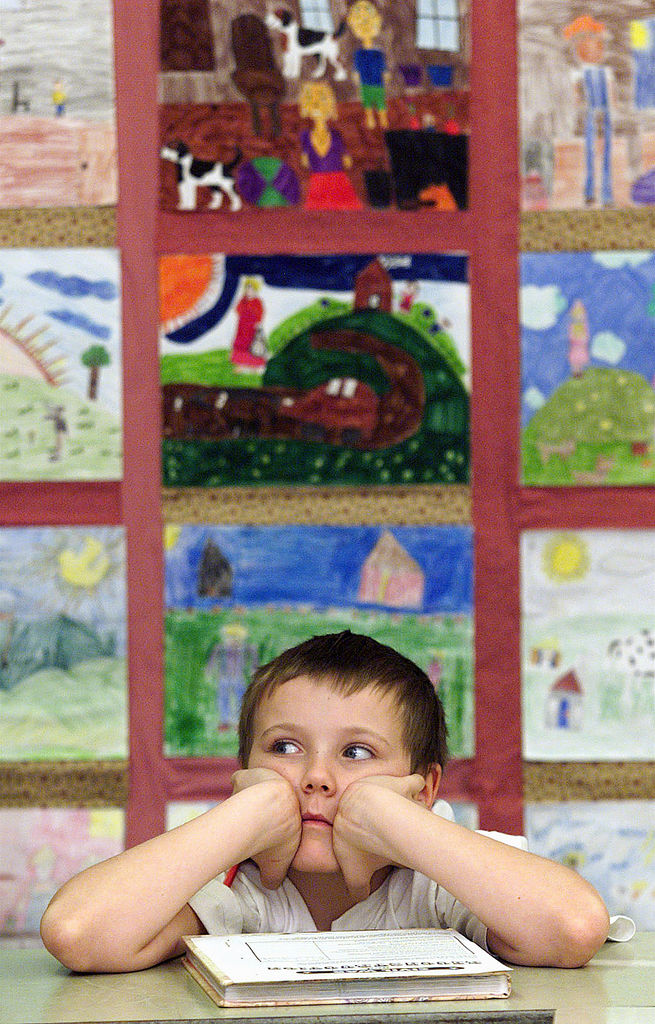
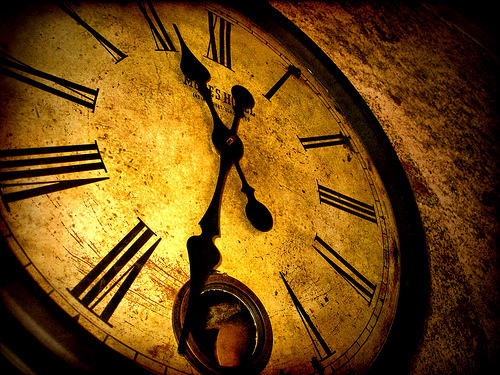
This post is a failure. It's on the subject of patience, and I was assigned to complete it yesterday. Why is it late? Because I confused patience with laziness.

But let's ponder for a moment what the digital age has done to those of us who have honestly considered ourselves patient people.

Those of us who are 30-somethings (give or take a decade or two) have no problem recalling a now-bygone era in which we had a specific procedure for contacting a faraway friend:


  1. Write postcard


  2. Place stamp on postcard


  3. Drop postcard in mailbox


  4. Wait three weeks for reply


We had a name for this. We called it "normal."

How have we improved in thirty years? Today we fire off an email that took us all of fifteen seconds to write. If we don't have a response back in a few minutes, we're irate.

What happened?

Time is money

We seem to have been poisoned by a couple thoughts:


  • My money is more important than your obstacles to getting me my money.


  • If time is money, and you're making me wait, then you're using up my money.


This argument looks sensible. But it has a fatal flaw: it turns us all into greedy slavemasters of other people's minutes and seconds, and justifies the transformation in the name of progress. We expect immediate responses, and others expect immediate responses from us. The problem, of course, is that we've conditioned ourselves to assume that each of us is the most important person in the world (when, in actuality, of course, only I am the most important person in the world).

The flip side of patience

Some people say they don't have a problem being patient.

It's easy to say that when you want to hide either that you lack the courage to take action, or you simply don't care. Even though they can have an identical appearance at face value, there's a wide and consequential difference between patience and fear, and a similar difference between patience and apathy.

We should be careful not to be too impressed with those who claim great patience when it is really just a spurious cover for their vanity and pride. We should be even more careful to expose and eradicate such falsity in ourselves.

All that is necessary for evil to triumph is for good men to do nothing.
--Sergei Bondarchuk


When we use patience as an excuse for inaction, we preserve evil's grip for a while longer.

Deeper thoughts...

Love is patient...
--1 Corinthians 13:4 (NIV)


...the fruit of the Spirit is love, joy, peace, patience, kindness, goodness, faithfulness, gentleness, and self-control.
--Galatians 5:22-23 (NIV)


...Those who wait on the Lord shall renew their strength...
--Isaiah 40:31 (NKJV)


There is a time for everything...
--Ecclesiastes 1ff. (NIV)


Nowhere in these passages is it suggested that patience is a weakness. Meekness and humility may be hallmarks of the individual who embodies all of the above characteristics, but patience is apparently part of a set of characteristics that demonstrates acts of power. The fruit of the Spirit is the fruit of that which created the cosmos ex nihilo.

Patience here is waiting for the right moment to achieve maximum benefit. It is proactive and strategic and intentional. It is the ninja who hides in the shadows for three days, barely breathing. It is the comedian who inserts a dramatic pause at just the right moment before the punchline arrives. It is the God who is there waiting in the midst of the situation before we need him.

"Be holy," God says, "because I am holy" (1 Peter 1:16; cf. Leviticus 11:44, 19:2). If we are to assume that our own holiness is an intentional attempt to mimic the qualities of God, then our benchmark for patience is the dynamic Spirit whose patience is as limitless as is his power.

Wait for it, wait for it. Give it some time.
--Howard Jones, "Everlasting Love"


This post is part of
Bridget Chumbley's One Word at a Time Blog Carnival.
Previous carnival entries have focused on lust, love, church, and peace.