Thursday, December 31, 2009

Top five posts for December 2009


Creative Commons: dsevilla


New to the blog? This is a great place to start!

The top five posts for December were:

  1. What's the big deal about Web 2.0?

    The Internet changed the way we live, work, and play. But then the Internet changed. How is it dragging us along with it now? Or, put another way, how have we regained the power to drive the machine ourselves?


  2. How to make friends and be influenced by the right people

    Everyone wants to be a leader these days. How can you be a credible follower first? This is a primer for introverts and extroverts alike on initiating quality relationships with folks whose influence you deeply desire.


  3. Why do I blog?

    There's a reason I do this. It's not egocentric. It's actually quite the antithesis.


  4. Love

    Love can destroy the world. This is really good news if you have any complaints about how horrible the world is these days. Read this to find out how to become a destroyer.


  5. Church: a community for itself, or something else?

    Does the Church exist for the sake of the people who show up, or for God, or for the rest of the world that it's trying to reach?

    Uhm. Yeah, it does.


Questions.
What was your favorite post in this blog?
What do you wish I'd written about? (I'll consider it!)

Tuesday, December 22, 2009

Love


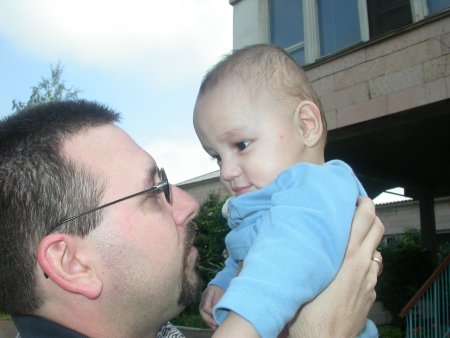
Me and my son
(August 13, 2004, Uralsk, Kazakhstan)
Photo by my wife


You wanna destroy the world? Do something loving.

No, really.

The world as it was up until that point will cease to exist. It will be replaced with something entirely new and amazing.

I loved someone once (among other times). He didn't like me very much the first day, but I was actually prepared for that. The photo you see above was taken the second day, when the two of us finally made eye contact and more or less agreed to put up with each other for the duration.

The result five years down the road is a dynamic, constant, mutual exchange of devotion and growth, frustration and resolution, communication and joy. I'm not sure which one of us has been transformed by it more. Fatherhood is a fascinating beast. Sure, Alex is not the little boy he was when we adopted him. But then again, I'm not the man I was when I landed in Kazakhstan to meet him. The world I knew ceased to exist that day.

Love changes everything. It is a radical, transforming, impenetrable, monolithic, violent, dangerous, unpredictable, radioactive fire of a billion suns. You get a choice: either learn to direct it well as it destroys what is wrong, or you will unintentionally destroy others by it, or you will be destroyed by it.

This Christmas, how will your love destroy the old world? I wonder what the new one that replaces it will look like.

You have your assignment. Go!

This post is now part of Bridget Chumbley's
One Word at a Time Blog Carnival: Love
December 28, 2009

It is continued in part two...

Friday, December 18, 2009

How to make friends and be influenced by the right people


Rights granted under Creative Commons license


How do you find a mentor?

Before you win friends and influence people, it helps to know how to win friends and be influenced by people. By observing others, you'll identify qualities you wish you had. Then you can write down some goals for personal improvement.

If you want to become like someone else, you need to spend time with someone else. That's pretty obvious. We don't grow well in a vacuum. It doesn't really matter if you're an introvert or an extrovert. If you want to learn something and have it truly change you, you need to seek out advice from someone else who's done something like it. The best way is to interact directly. You'll find out not just the information, but the motivation behind the information. Instead of becoming an encyclopedia, you'll become a more aware human being.

If you're like most of the human race, starting this kind of conversation is awkward and difficult. Yes, you actually need to try to get someone's attention. The dividing line between being a pupil and being an annoyance can get pretty thin sometimes.

Vying for attention is the first step to communication.
Tweet from @vocalexpert


So how do you do it?

  1. Be proactive. Go do it.

    People are generally impressed with those who recognize that something needs to be done and then take initiative. Be that kind of person. If it takes courage to do something, it takes a lot more to do nothing and expect things to change anyway. (Minimize courage?)


  2. If you want something, go get it!
    Stop wanting, and start having!

    Tweet from @ScottWilliams (Read more from Scott at his blog.)


  3. Be nice. "You can catch more flies with honey," said my great-grandmother, "than you can with vinegar."

    Actually, I have no idea if my great-grandmother said that. I never met her. But she probably would have said something like that. If you want to establish a relationship with someone, be friendly. Yes, that requires some work on your part. If you never get to this foundational step, you'll have a hard time.

    Say hello. Start a conversation. They probably don't bite.


  4. Want someones attention??? Be kind...People dont care how much u know, until they know how much u care...
    Tweet from @RevRunWisdom


  5. Be relevant. You don't have to be an expert on the subject that you're trying to become an expert on, but at least be on subject, please.

    Offer something. Or parrot back something interesting (or controversial!) you heard from someone else. It stimulates conversation.


  6. Stay on target!
    Gold Five, Star Wars: A New Hope


  7. Be lighthearted. It's been said that one should avoid humor, but not avoid humor entirely. See here for maven David Pogue's take on when humor shows up in tech. Consider also the advice of Oscar Wilde: "Seriousness is the last refuge of the shallow."

    Don't take yourself so seriously that you hurt something. This doesn't mean that you need to be the comedian all the time, but it does help to be flexible enough to inject levity in an otherwise tense situation. People will come to appreciate your skill in this.

    You don't need to be absurd, but you can be relevant without being dry.


  8. People will never forget how you made them feel.
    Maya Angelou


  9. Be sincere. If people don't think you mean it, you probably don't stand a chance.

    But that's not the point. Don't make them THINK you mean it. Just mean it! If you don't mean it, please, don't waste time. Do something that matters to you.


Growth can happen fast or slow, sometimes in our control, and sometimes not. But the alternative to growth is not stagnation. It's regression by proportion. If you're not growing while progress is taking place around you, you're falling behind rapidly. It's time for you to get up and move.

Speaking of which...

Monday, December 14, 2009

Church: a community for itself, or something else?


Creative Commons: http://www.egyptmyway.com/photo/holy_family2_2.html

This post is part of Peter Pollock and Bridget Chumbley's Blog Carnival.


Is the Church about itself? Or is it about everybody else in the world outside it?

Or is it about something else entirely?

Those are probably the only three choices. You have to pick one of these:

  1. Church is about the people who show up. It's a social, community-oriented structure. All the rest is details. It's just about God's people learning to work together as a team and enjoy each other's company. God's new society is made up of potlucks and Bible studies, coffee hour and field trips.


  2. Church is about God. It's one or more people worshipping. Nothing else matters. Everything should be done with absolute dignity and solemnity, and there is no room for human sentiment or opinion of any kind whatsoever.


  3. Church is about reaching the world. The whole purpose of the Church is mission. Everything else should take second-seat to the task-at-hand. The "seeker-service" should be the norm. Mature Christians who are trying to grow can go to seminars if they want to.


The criticisms against each of these models are worth reviewing. If the Church is about people, have we so removed God from the equation of the potlucks and committee meetings that there's no room for God anymore, and no difference between the Church and a rather smug country club? On the other hand, if the Church is only about God, then aren't the people irrelevant? Can't we just stay home? God is God regardless, right? And on the third hand, if the Church is strictly about the mission to the world, then there is nothing in the Church for those of us who are already there.

We have a remarkable tendency to criticize those who disagree with us on this question. I admit, I struggle with this one. Once upon a time, I confess that I left a church because I began to fear it was too much about itself to legitimately be about God anymore. I may have judged that one too quickly and too harshly.

Because maybe the whole discussion isn't even necessary. Maybe it's all three. Can you separate God from the mission of God? If God's intentions are always realized, then His intentions *are* his character. Can you separate the mission of God from the servants He's empowered with the task of carrying out that mission? Can you imagine the community attempting to actualize that mission without taking part in worship?

The Church is a community of like-minded and mutually-supportive individuals in agreement on these general principles:

  • There is a God.


  • This God desires and deserves our devotion and affection.


  • This God listens to what we have to present to Him.


  • This God calls us to be involved in His plan to revitalize and perfect Creation.


That's all three models wrapped up into one single package.

Questions:
Which of the three models have you been giving the least emphasis to?
How would the expression of your Faith improve if you cranked up your implementation of that model?

Thursday, December 10, 2009

What's the big deal about Web 2.0?


Let's take a look at what Web 2.0 is and what it is not. We'll start with the world's shortest history lesson.

Web 1.0


I wrote my first web page in 1996. When the WorldWide Web was implemented, the initial key features were these:

  1. Present content. Offer users information that they want at the click of a button.


  2. Relate content. Connect things. Link words to other related locations. Create relationships between documents and ideas.

    This is what the HT in HTML means. "Hypertext" is text that connects to other text, in this case through links.


  3. Right here, right now. Make information (including personal emails!) available at any computer you sit down at.

    Now your data is no longer tied to your home location. It's out there in "the cloud" and you can get at it any time you need it, no matter where you are.

    Hello, new security models and implications! Gotta remember those passwords now.


  4. Images (and media). Provide pictures, video, and sound. Compress to the smallest size possible or you'll lose your viewers to the annoyingly long transfer times. Adapt industries to new needs for storage space both centrally, and on the user's terminal.


  5. Develop new revenue models. Offering content online shifts the way people look for emerging facts. Newspapers are challenged to keep up with this trend and rapidly shift to web presentation. Advertising techniques adapt, especially with the creation of the now-ubiquitous "banner ad."


But all of this was still directed at how to present static content to an enduser, and direct an enduser to the content a provider wanted them to request.

Fast forward 13 years later and it's a revolutionary world all over again.

Web 2.0


The Web was first a repository for permanent content. It's now a place to interact. Today, everyone makes his or her own content. It's dynamic. It doesn't expect the user to come looking for content, but it adapts to the addition of new content by the user.


Keys to this new world are:

  1. Access. You get to manage who has access to your data.


  2. Individuality. The content you want is delivered to you in a way that suits you. RSS feeds, user preferences, and "skins" make your experience of reading someone else's content as unique as you are.


  3. Easy media. You get to create and share pictures, sounds, and movies.

    The Web initially allowed you to find someone else's movies. Now, anyone with a reasonably recent cell phone can be a movie producer, a songwriter/musician, or a photographer. There are all sorts of places and ways to store, access, share, and control your media files. Basic tools for creating and editing are generally free.


  4. Collaborative environments. Once upon a time, great columnists received fan mail (or hate mail), and occasionally responded. Now, all blog platforms incorporate tools for interacting with readers in nearly real-time.

    • Wikipedia was built by (mostly) altruists who started with zero content and the hopes that people would pour their knowledge into an open forum. (It worked.)


    • Social networking sites have become the dominant force on the Internet, making interaction king.


    • YouTube encourages video responses to postings, resulting in a sort of ongoing video conversation.


    • Google Docs and the new Google Wave extend this trend exponentially, allowing teams of users to interactively contribute to the development of a project.


  5. Ubiquitous metrics. It used to be that you had to have a marketing degree to know who visited your site and why. Now various applications open this to anyone and everyone. You can view your own site statistics in real time and then tailor your content as you see fit.


Working together


The Web may have initially brought the impersonalization of technology to the masses. But if so, the masses have adjusted the technology to inject personality back into it.

What's Web 2.0 about? It's about me and you working together.

So, what do you have to say about that?

Question: How have online tools changed how you interact with people you know?

Monday, December 07, 2009

The Internet is not your delivery boy


A few years back, a CEO interviewing me for a job in his company asked me, "How do you learn?"

I never really gave a convincing answer. But I think I came a little closer when I discovered this blog:

http://www.churchmarketingsucks.com/archives/2009/11/the_internet_is.html

The most important line in here is something I've thought for years, but something that's becoming increasingly clear from the advent of "Web 2.0" and related terminology, social networking, community-building:

The Internet isn't powerful because it connects you to information,
but because it connects you to other people.


Knowledge sitting there and flapping in the breeze is passè.

Knowledge acquired through interacting with someone that you sought out because you knew they possess it...? That's cool!

Since I know you're wondering, my attempt in that interview was enough to please the CEO. Although I thought the subject deserved a book or two, I went home and wrote a three-page manifesto on how I acquire knowledge. But one of his underlings threw a wrench in the decision, and I didn't get the offer. I was grateful for his question all the same. It's stuck with me for several years now.

We learn because we seek out people who pass on knowledge. We use the best method available to do that.

Originally posted on LiveJournal.

Question: What expertise are you passing on? To whom?

Saturday, December 05, 2009

Why do I blog?


It's about people. Like you.

This whole blog might occasionally look like a potpourri of topics, but in reality it's about connections. When we make a connection, our world expands a little bit. We learn something. We grow. We have an opportunity to develop something meaningful and deep and quite possibly lasting.

When we make a connection, we have an opportunity to be of use. If we sequester this new knowledge like it's top-secret, we render it inert and useless. If we openly share it, then we have value.

Growth is an endless cycle of making connections, seeking connections, and offering connections.

This blog is about three kinds of connections.

  1. Connecting people with people. What else can possibly play a larger role in our progress? Think about the people who mean the most to you. With the possible exception of your mother (if she's on the list), there was a moment for all of them at which you did not know them yet. Something happened. A connection was made. Your life was enriched, and you enriched the life of another.

    It makes me sad to meet others who aren't interested in making more connections with people. This isn't simple introversion. There are introverts and extroverts in this crowd. It's more like low self-esteem. It's an active refusal to recognize self-value and admit that others might actually like to find out more about you.

    At this holiday season, make an effort to reach out to three new people. These could become the most significant friends of the remainder of your life!


  2. Connecting people with ideas. New knowledge allows us to make more responsible decisions, and to relate better to the world around us. We learn, we grow, we test, we fail, we learn some more, we master, and then we teach.

    Our responsibility is to maintain minds open enough to recognize new good ideas, and to internalize and then actualize the best of them so others can benefit from it. Once a good idea has been connected with us, we should then connect it with other people.


  3. Connecting ideas with other ideas. Knowledge builds. And insights come from knowledge on lots of subjects. You can be an expert on math, or on religion, or on science, or on history. But you'll be a better expert on history if you have some understanding of math and religion and science.

    So you'll see posts here that make connections between seemingly unrelated issues.

    The biggie will be how to use technology to connect other knowledge to people. That's what we instructional designers do.


What seemingly unrelated thoughts crossed your mind as you were reading this post?

Wednesday, December 02, 2009

Personal principles for instructional design


Every Instructional Designer needs to know certain basic things, like
  • the ADDIE model

  • Kirkpatrick's scale of assessment

  • general adult learning principles

  • Bloom's Taxonomy

  • how to develop relationships with SMEs

  • how to complete a task analysis


But I also have a few general principles that I apply to my work. This list is constantly undergoing revision.

  1. I hate most CBTs (Computer-Based Training). They're so easy to tune out.


  2. I write CBTs. I don't want to write something that I'd hate to take. Therefore...


  3. Be interesting, but don't be so interesting that the learner is more enamored with your personality than with the material.
    Course material is for the purpose of transferring knowledge to the learner, not for impressing the learner or the Instructional Designer's manager with your intelligence, capabilities, knowledge, or tech savvy. You want the learner to remember the material, not you.


  4. Don't be boring.


  5. Few words. Type a little. Speak what must be said, no more.


  6. Borrow existing material as much as possible. Shorten development time.

    This is the hardest for me to apply for a few reasons. First, it's immoral to plagiarize. Second, my own sense of personal responsibility says I shouldn't write about something I can't comprehend. Third, I think it's cool to become a SME.

    But the bottom line is...well...the bottom line. Corporate responsibility calls me to efficiency in the construction of materials. If the wheel already exists, do not reinvent it.


  7. DO! That is, create an exercise for the learner. But remember that interactivity is a tool to reinforce knowledge acquisition, not distract from it.


  8. Likewise, avoid technical gadgets unless they enhance the presentation of knowledge. Simple text transitions that synchronize with audio are encouraged. Complex text transitions only make us think, "Gee, isn't PowerPoint neat!" That's pathetic. We're not trying to sell PowerPoint.


  9. Avoid humor. But do not avoid humor entirely. Consider this blog post from maven-guru David Pogue.


  10. Always, always, always have a knowledge check at the end. People need to be held accountable. No matter how simple the training is, trust that the learner CAN be responsible to apply knowledge to real-world situations. Prove it.


This was originally posted on my old blog