A quote from an interview with Johnnie Cowie, a british convert to Orthodoxy from atheism:
One of the unique things about being Orthodox in Oxford is that there is a Greek parish and a Russian parish, and over half of the services are either in Slavonic or in Greek. For me that has been a good thing, because it means that although half the time I can understand every word of the service in English and relate to what’s going on intellectually, at other times I am completely unable to, which means that I have to attend more to the intuitive, the visual, the bodily.
(From http://www.pravmir.com/article_6.html)
(From http://www.pravmir.com/article_6.html)
Mystery. Mystery is the key to Orthodoxy, and to deepening ones faith in Christ.
A rational and intelligible and manageable faith places me at the center, as the director, with me in charge. "I am the captain of my soul," one might say in such a situation. Thus was the tradition in which I was raised. Certainly we were supposed to be devoted to God. Certainly we were supposed to grow in our faith. Certainly we were supposed to be wise to our own sins and submit ourselves as "living sacrifices" as it were (Rom. 12:2). We were on our own to figure out how! We were taught--rightly--to honor God with our heart, soul, mind, and strength. It was that third category which drew me in. To not think more deeply each day was to dishonor God! God took hold of the heart by invitation, and then I brought my mind along for the ride. And so I read. And studied. I swallowed up anything I could that was in print. I listened to sermons from every wise pastor on KFAX. (Oh, how I relished the teachings of John MacArthur and Jack Hayford! ...And why is it that all the good preachers are in California? ...and post-denominational?) I filtered out the heresies of the Tübingens from the refreshing water of the neo-orthodoxers (why is it that most of both were German?). I could defend Augustine from Pelagius--as if he still needed the help. My mind was attuned to God, and my faith made sense. It was internally consistent. It was rational. It was based on a God who was believable. I unlocked God's truth one verse at a time (borrowing from the website of the church of the aforementioned John MacArthur), as if the Scriptures had been dropped in our laps and it was left to our devices to figure out how to build a church around them. My mind was aflame.
And it stopped.
There was an ending point. Or, at least, there would have been an ending point if I'd reached it. The ending point was the limits of my own rational capabilities. There was no way past this if my faith was rational, if I was the director of my growth. I was my own limit. Whatever I could imagine and attain...wasn't infinity. It was subject to the limits of human capacity. Stagnation was the ultimate end, a festering, putrid pool of mental uselessness that could regurgitate much, but ponder nothing new. My mind was set. God said it, I believed it, that settled it. I was saved because I prayed a prayer and prayed it sincerely (and I did!), and Charles Stanley patted me on the back through my radio and said I'd be okay. My mind was becoming the Dead Sea, a place for recreational health spas and Israeli gunboats.
I was disturbed by those around me who had little to offer in the way of encouragement. "I'm happy in my faith," they'd say. "I read my Bible and pray and go to church and I only listen to DC Talk and Steven Curtis Chapman and..." I could close my eyes and picture them saying it with a plastic smile and all the sincerity of Simon Cowell asserting, "...and I like puppies." *They* actually believed it was enough. They actually believed that intellectual stimulation and growth was unnecessary in the Christian life, that stagnation was okay, that so long as you weren't poisoning your mind with disgusting books by Stephen King and homophilic music by Melissa Ethridge, you were plenty okay! You had arrived. Your salvation was complete. What more did you need?
I was defeated. It was not exactly a crisis of faith. My belief hadn't changed. Why would it? My mind was set! But I had no home. So I went with the flow. I went to church and read my Bible and listened to DC Talk and Steven Curtis Chapman. And I felt okay. Very...mediocrely...okay.
I tried Orthodoxy, but that was just completely unintelligible. "How?" I asked myself. "How could these superstitious dimwits actually believe that mechanical repetition of the same script every week might CHANGE you, might help you GROW nearer to God?? It's just the same thing over and over!" It was preposterous. Not only that, but they said you had to work on your salvation (not that Saints Paul and Peter and John hadn't said the same thing, mind you), and that the elements really *were* the Body and Blood of Christ (not that Jesus hadn't said the same thing as recorded by his friend Saint John the Apostle, nor that Saint Paul wrote to the Corinthians with the same level of immeasurable respect for the bread and wine, mind you), and that *things* could be holy (not that this wasn't clear especially from the Old Testament, where God inhabited a Temple, but also in the New, where Saint Paul sent his hankies about to heal folks, mind you). Things??!? I was as incredulous about that as the Muslims were that God could corrupt Himself by taking on something so despicable as human flesh, and I didn't have a problem explaining that one, of course. But God wouldn't bother with an inanimate object anymore! God was LIFE!
See? Orthodoxy HAD to be wrong because I SAID SO. And why not? I was in charge. My mind knew best. It was being directed by the Holy Spirit in my heart.
Right?
...I think.
But then again, who was I to tell the Holy Spirit in my heart how He could lead me?
I made a mistake, a slight miscalculation. I started asking people about their experiences in the Orthodox parish I was attending. I expected them unanimously to complain and whine about how their faith had no meaning, which would afford me a fantastic evangelistic opportunity to lead them to deeper study of the Scriptures and acceptance of the developments that had taken place in the church for the 1,800 or so years they'd been ignoring it.
Wow, was I wrong. My intellect blew it. I picked up my jaw off the floor the first few times that folks shared with me what God was doing in their lives. These people were believers. These people were CHRISTIANS! Something dynamic was going on in them, and constantly! Suddenly, I was on the defensive! I wasn't the one in the superior position. Those same "superstitious dimwits" were explaining faith to me without necessarily having cracked open their Bibles all that much. Something else was informing them, and in Truth, too! What was more, about a third of them I talked to had chosen this Orthodoxy! And the priest was one of them! (I should have noticed that "Dumont" isn't exactly a Greek name, duh.) But I didn't get it. Why would a legitimate Christian CHOOSE the easy path of repetition, a faith in which you don't have to think anything at all, if...
...If...
Then it hit me. They were out-thinking me. These untrained, undereducated, superstitious dimwits were thinking and articulating and sharing thoughts that were a hundred-thousand times deeper than anything I'd ever tried, and it was BECAUSE they were Orthodox. And they weren't even proud of it. They were naturally humble about it. They didn't speak of it regularly because they simply didn't notice it was anything of interest. It was NORMAL. Their hearts AND minds were alive, on fire for God, they were taking the plunge, and they hadn't found the bottom yet. I had been transforming me, but God was transforming them. The impetus to work on their salvation was driving them nearer and nearer to the bosom of Christ, to trust and intimacy, to seek refuge in the Lover of our Souls, the only hope they had of accomplishing much of anything of significance. But I had no such impetus, because I was already at the pinnacle of what I thought my Faith could attain. And the holy things? A sign: If God could transform an object, how much more could he transform a human being? And Communion? A holy, transformed thing itself, AND a transformed human being simultaneously, a created object with divine significance, the Flesh and Blood of an eternal human being, according to the pattern human beings were always supposed to have, a small dose (as if one needed more) repeated regularly to affect the same sort of renewal in us.
I found myself thinking of Jacques Cousteau, and I imagined... What if a young Cousteau had gone to the beach his first time on a gray, misty, windless day and been uninspired. "That's it?" he could have said, irked at the person who brought him there and wasted his time. "Just gray as far as the eye can see?" He would have dismissed it with a shrug and never come back. But we know this is not what happened. Cousteau dove. He went deeper. He found he could never get to the bottom. Under the surface, it was alive! "They say the sea is cold, but the sea contains the hottest blood of all, and the wildest, the most urgent," penned the poet D.H. Lawrence. There was always someplace more to go, something new to discover. Lawrence continues, "...all this happiness in the sea, in the salt where God is also love, but without words..."
And so in awed but cautious silence the complacent one dusted off the old equipment and went back to being an explorer.
I discovered a depth I couldn't fathom, a help I never knew was there, a life far richer than anything I'd ever known. I found people who chuckled at and then dispatched with theodicy as if it were a child's game (and I'd been looking for those folks for a while, admittedly). I approached the icons there and venerated them, imploring, begging the Saints depicted therein for their help and prayers before the throne of God (that my intellect had told me previously I could--and should--approach just fine on my own...but why not ask for help if it's there?). I was touched, and I can't explain how. I found myself with the opposite cry, in anguish: "Why!? WHY did we throw this all away and assume the church was ours to meddle with and decide how it should look and what it would feel like? How did we forget that *God* made this Church at Pentecost and preserved it so we could draw near to Him and keep growing?" I was deep in the Mystery. I couldn't solve it, wouldn't ever be able to solve it, didn't want to solve it, because it wasn't in my power and wasn't my place to solve it. It wasn't my purpose to solve it. This was the comfort I needed, the reassurance that God was (as Karl Barth had assured us all in the 20th century) "wholly other" (or, as VeggieTales had said, "bigger than the bogeyman").
But I was hungry, and I still couldn't have Communion. Why are the Orthodox so adamant about keeping the Chalice closed? Would you allow your most prized and valuable possession to be borrowed by someone you did not KNOW for SURE would use it properly? The Orthodox are justifiably a bit suspicious of the spiritual intentions of those who are spiritual descendants of people who turned their backs on Orthodoxy. Even western Protestantism has sprung from western Catholicism. ("What?" you say? "My forebears LEFT the Catholic Church so they could return to the 'TRUE' faith?" Oh really? Then why did they have to put together a committee to create something new, decide how it should function, subject to quarterly review and annual votes by the national administration?) Part of the mystery of the Church is that its unity is preserved by God. If you are not seeking to unify it--and unity comes through the assent of the will of the individual--perhaps then you accept and encourage the status quo of its continuing fragmentation? "I deserve Communion. Because I'm good enough! Because I SAY SO!" There's that intellect in charge again.
Humility. I stuck around in my previous tradition for a while longer because I could be noticed. I wanted to be a great speaker, a great leader, a great author, a great singer (ha!). But Jesus said, "If anyone wants to be first, he must be the very last, and the servant of all." I'm still not quite comfy with that, but I have to learn to put up with it because I'm not in charge anymore. At least, I'm not supposed to be. I'm learning every day a little bit more. I'm growing again. "I will not give you a kiss as did Judas," says the prayer repeated immediately before Communion, "but as the thief I confess to you, Lord, remember me, a sinner." A man who's put in his place is a valuable tool in the hand of God. Through the door of humility there is great capability. It does not make sense. It is paradox. It is mystery.
And so, if you can't beat them, join them. When the oil of chrism was finally placed upon me and I was made part of the Church, I hoped and seriously expected to see a vision of a ladder at the altar in the front of the church, with angels ascending and descending to minister to us. I saw no such vision, but I knew it was there all the same. I've spent about a quarter of my active, intentional, committed Christian life now in Orthodoxy. I still don't understand the Liturgy. Oh, I'm getting better with the Greek! But, as Johnny said above, when I can't understand what's going on, there's always something else to attune to, some other level of activity swirling around me, Saints praying for us, movement, people doing prostrations, crossing themselves (a "physical prayer," flesh in the process of transformation doing an inherently Christian action), watching to see where the Gospel or the Chalices (each representations of the presence of God) are being carried, kneeling in fear because a miracle is about to take place (a miracle so powerful that the special effects in the first Indiana Jones film seem pretty lame to me now). The Liturgy is alive. It may be repetition, but it is alive. And wild. And urgent. I don't understand it, but it sure is full of dignity and awe and reverence.
And the repetition isn't so bad anymore. In fact, here's something I get out of it: "Let us commit ourselves and one another and our whole lives unto Christ our God." I'm not on my own anymore. I'm responsible for the guy in the pew next to me. And he's responsible for me. I bring him to God, and he brings me to God, and when one of us stumbles, we call around for help. We have a community. We have holy things--things that God has touched--around to help us. We have people who are further along the path--even, in many cases, over the threshold of the other side of life--praying for us. And we're getting there, slowly.
How is it happening? I don't have a clue. And I like that, because my God is bigger than me now, and always will be.
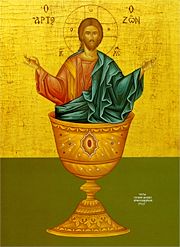
Christ, the Bread of Life
If Communion gives us life,
how could he NOT be present in it?


